Subscribe To


 Posts
All Comments
Posts
All Comments
Wednesday, November 30, 2011


Tuesday, November 29, 2011

Tuesday, November 22, 2011
| Obama projects Pacific power | |||
What's the real story behind Washington sending a bunch of marines to Australia?
Pepe Escobar Last Modified: 22 Nov 2011 10:30
| |||
One would expect a Pacific/peaceful power to promote, well, diplomacy and peace. Not really. Not when the key scriptwriters of the President's offensive - "turning our attention to the vast potential of the Asia-Pacific" - come from the Pentagon. Washington may not be on the verge of an Occupy Australia gambit - but one's got to start somewhere. The start is 250 US Marines deployed as part of an Air-Ground Task Force to bases in Australia's Northern Territory, including Darwin - which is a stone's throw from Indonesia, and thus, Southeast Asia. US Air Force fighter jets will also be in the house, with the Marines on six-month tours starting in the summer of 2012 up to an eventual rotation of 2,500 troops. Then comes the whopper. The marines will be conducting war games on Australian soil "out of the reach of Chinese ballistic missiles". And no one told an unsuspecting world that Beijing was about to establish a unilateral no-fly zone to conduct "humanitarian" bombing Down Under. Here's the scene The hardly subtle Obama spin is that China must "play by the rules of the road", and stop its "military advances". This Washington narrative implies a benign superpower - the US - intervening to protect an Asia under siege. Reality tells a completely different story; the "rules" - imposed by the US - assume that Washington has the right to (aggressively) police the whole planet. Beijing, for its part, is planning, long-term, how to defend its multiple national security interests in the South China Sea, the Indian Ocean and the Western Pacific. No less than 85 per cent of China's imported oil and gas travels across the Indian Ocean, through the extremely sensitive Malacca Strait, towards China's ports in the Pacific. Sure, China is investing heavily in Pipelineistan from Central Asia and from Siberia and is increasing energy imports from Africa. Still, two of China's three top energy sources are Saudi Arabia and Iran (the other one is Angola). This means China needs to build its own defence/protection mechanisms for an immense merchant fleet plying the Indian Ocean - and the Western Pacific. It's an utmost matter of national security. To rely on the US Navy to defend Chinese national interests would be suicidal. The junction of the Indian Ocean with the Western Pacific - where the South China Sea meets the Java Sea - is, for Beijing, the holy of the holies. That's the bottleneck its energy imports coming from the Middle East and Africa must imperatively negotiate. And that converges with a wealth of untapped oil in the South China Sea that Beijing plans to exploit. Here's the agenda Now imagine if Beijing decided to set up a base, say, in Catalina Island off the coast of California, or even in Hawaii, to patrol the Eastern Pacific. None of this warmongering, though, is new. Not only the map, but the figures tell the story. Almost 90 per cent of world trade and almost 70 per cent of oil travel by sea. Half of all the world's shipping container traffic crosses the Indian Ocean. And from the Middle East to the Pacific, 70 per cent of all global oil trade flows through the Indian Ocean. The US Navy 2007 maritime strategy calls for a "sustained presence" in the Indian Ocean and the Western Pacific. The US Marine Corps 2008 "Vision and Strategy" programme - which goes all the way to 2025 - stresses the Indian Ocean and environs will be a major area of conflict. So when Obama said the US is a Pacific power, he also meant that the Pentagon wants to be not only that, but also the top South Asian power. Forever. For all practical purposes the Pentagon has extended its self-described "arc of instability" to the confluence of the Indian Ocean and the Western Pacific. To top it off, it's gaming a new strategy, called AirSea Battle - which assumes that the People's Liberation Army (PLA) will "deny access" to US naval power in all the seas surrounding China.
Reposition me, babe So it starts with 250 US Marines. Just like in Uganda it starts with a few Special Forces. That's how it started in Vietnam in the early 1960s. And still the US keeps over 40,000 troops in Japan and over 28,000 in South Korea - decades after the (war) facts. Chinese Foreign Ministry spokesman Liu Weimin, in a masterpiece of understatement, said the new US move "deserves to be debated". Now this is how Beijing really sees it - as well as dozens of countries part of the Non-Aligned Movement (NAM). The Pentagon calls it "repositioning". It's the warlike equivalent of the revolving door between Washington and Wall Street. We take you from Iraq or AfPak and we ship to you Africa or Australia. The cover story - sold by a compliant corporate media - is that the US is repositioning itself as "a leader on both economics and security in the fast-developing Asia-Pacific". Pentagonism, as applied to Asia-Pacific, is an extension of the Pentagon's Long War - which has been the "soft" denomination of the Global War on Terror (GWOT) since 2001. See it as Global War Inc. And the new locations of choice are Africa (from Libya to Central Africa) and Asia-Pacific. Washington's wars in Iraq and Libya offered mixed results. Iraq was a defeat of historical proportions - and China in the end was not locked out of the oil (on the contrary). Libya - for the moment - is a "victory", with China virtually locked out of any new oil and gas contracts. Now not only the Pentagon has launched a Cold War against Chinese commercial interests in Africa, it's encroaching on China's own maritime backyard. And by inverting all the rules of logic - posing as the usual, non-threatening benign outside power. Obama said explicitly that if Beijing does not respect "international rules", the US "will send a clear message to them that we think that they need to be on track in terms of accepting the rules and responsibilities that come with being a world power." Translation of this "clear message": "Occupy Australia" is just the beginning. There's no business like (expanding) Pentagon business.
Pepe Escobar is the roving correspondent for Asia Times. His latest book is named Obama Does Globalistan (Nimble Books, 2009).
|

from http://www.aljazeera.com/indepth/opinion/2011/11/20111121134858987329.html |
Monday, November 21, 2011


Thursday, November 17, 2011
No to US Hegemony in South-East Asia
Was researching, irate after hearing Obama's address to the Australian Parliament where he laid out his plans for a military presence in Australia and agressively asserted US power and control in the region and interest in it's resources and found this pithy paper. Published in 2003, it is dead on and even more relevant now in 2011. The US plan for global hegemony it describes has gone precicely according to plan, and this next step is an enormous threat to our liberty and security, despite Obama's silver-tongued, audaciously manipulative double-speak to the contrary. It defies logic that any country in the world should feel that it should hand it's power, land and resources over to America, which is both financially and morally bankrupt.
We need to oppose this as strongly as though our lives depended on it, as they just might. I agree with Bobby Tuazon [Peace researcher] 's closing statement with a deep conviction and believe in the need to take a stand and action to prevent the self appointed "world super-power" from waging an open ended "war against terror" [read- war against anyone who stands in the way of American interests] "Let us instead turn America's "war of the century" into the "Century's War Against US Imperialism"."

Current US Hegemony In Asia Pacific by Bobby Tuazon
Peace Researcher 28 – December 2003
This is based on a paper bearing the same title that was first read in a Power Point presentation during a Workshop on Asia-Pacific, sponsored by Bayan and the International League for Peoples' Struggle, at the Conference on War and Globalisation on March 1, 2003, held at the School of Economics, University of the Philippines, Quezon City, Philippines. The conference was sponsored by IBON Foundation. Bobby Tuazon works at the Center for Anti-Imperialist Studies. It was written during the build up to the Iraq War.
Over the past two decades particularly after the fall of the Soviet Union and the Eastern European revisionist bloc of countries, the United States has waged wars and covert operations in many countries. Unlike during the 40-year Cold War when such actions had to contend with impediments arising from the Soviet veto power in the United Nations and by the existence of strong liberation movements, the recent years saw the United States displaying its unipolar power with arrogance and self-righteousness.
We have seen this, for instance, in its wars against Afghanistan and Iraq where President George Bush, the Pentagon and the State Department have time and again declared or hinted that they will not be bound by international law, by institutions like the United Nations, or by world public opinion including appeals by Pope John Paul II and the former South African President, Nelson Mandela, as they decided the fate of Iraq in the pretext of disarming Saddam Hussein's regime of weapons of mass destruction (WMDs). And as the whole world knows, not one single WND has been found in Iraq by the US and its fellow colonisers. Ed.
To a growing number of people in the world today, however, it is clear who the greatest threat to international peace and security is. Eight out of ten Americans, according to a recent Time magazine poll, see the US as the world's greatest threat. Very distant second and third are North Korea and Iraq, respectively.
Many people, whether here at home or abroad, ask what really drove George Bush and other superhawks in their tenacity and arrogance to attack a nation of 26 million who continued to suffer the effects of the 1990-1991 Gulf War, years of economic sanctions and deprivation and continuous bombings despite fruitless calls from UN members to stop what appeared to be an insane war. A former Justice Minister of Germany likened Bush to Adolf Hitler. Nelson Mandela doubts that Bush can think coherently. These are of course remarks by leaders meant to warn the world about a cowboy and a Rambo gone berserk.
There is no question that the war on Iraq had another agenda to it, which is in relation to the control of oil and the perpetuation of American hegemony and world domination.
I will not dwell on the economics of the US war on Iraq and instead share some insights related to the greed of the Bush Administration to perpetuate American hegemony and world domination. First of all, the US war on Iraq, dubbed as the continuing "War On Terror," is part of a coherent world strategy that was conceived more than ten years ago.
Roots Of The Grand Strategy
The Bush regime's grand strategy for domination and hegemony of the world extends beyond the "War On Terror". This ambitious strategy can be traced in: the Defense Policy Guidance (DPG) of 1992 and the Project for a New American Century (PNAC), founded in 1997.
The DEFENSE POLICY GUIDANCE of 1992 is a top secret blueprint for world domination prepared by the Department of Defense (DoD), of then US President George Bush, Senior. Its vision is a world dominated by the unilateral use of US military power to ensure Pax Americana; to assert the US national interest; and prevent the rise of any possible power competitor for the future.
DPG particularly stresses that America will not be bound to its partners and to international laws and institutions while it stresses a more unilateral and pre-emptive role in attacking its perceived enemies (terrorist threats and confronting rogue states seeking weapons of mass destruction or WMDs).
The blueprint also says that a war on terrorism must be launched. This war to be launched by the American Empire must be seen as a façade and just a part of a bigger strategy of projecting US military power around the world, especially Eurasia, and cutting loose the multilateral bonds that have constrained Washington's freedom of action and power.
The PROJECT FOR A NEW AMERICAN CENTURY (PNAC, 1997), on the other hand, envisions to consolidate and preserve Pax Americana through the 21st Century primarily by military power/hegemony and secondarily, by economic hegemony. In other words, to create a truly global empire by military force. "At no time in history has the international security order been as conducive to American interests and ideals. The challenge of this coming century is to preserve and enhance this 'American peace,'" its vision partly says.
In 2000, an election year in the United States, the men behind PNAC came up with a report, "Rebuilding America's Defenses - Strategy, Forces and Resources for a New Century". Its authors acknowledged that the paper was based on the 1992 DPG.
Four Core Missions
The "Rebuilding" report has Four Core Missions for US military forces:
* Defend the American homeland;
* Fight and decisively win multiple, simultaneous major theatre wars;
* Perform the "constabulary" duties associated with shaping the security environment in critical regions;
* Transform US forces to exploit the "revolution in military affairs".
To carry out the Four Core Missions, the United States must:
* Maintain nuclear strategic superiority globally;
* Increase active-duty strength of today's force from 1.4 million to 1.6 million;
* Reposition US forces by shifting permanently-based forces to Southeast Europe and Southeast Asia, and by changing naval deployment patterns to reflect growing US strategic interests in East Asia;
* Modernise current US forces selectively (such as sending more attack submarines to Asia; more electronic support, helicopters and aircraft for the Marine Corps);
* Develop and deploy global missile defences in order to provide a secure basis for US power projection around the world;
* Control the new "international commons" of space and "cyberspace" and pave the way for the creation of a new military service - US Space Forces - with the mission of space control;
* Exploit the "Revolution in Military Affairs" (RMA)
* Increase defence spending gradually to a minimum level of 3.5% to 3.8% of Gross Domestic Product (GDP), adding $US15 billion to $US20 billion to total defence spending annually.
Specifically, the PNAC project also advocates:
* A much larger military presence spread over more of the globe, in addition to the roughly 140 nations in which US troops are already deployed;
* The US needs more permanent military bases in the Middle East, Southeast Europe, Latin America and in Southeast Asia (where no such bases exist);
* The US will consider developing biological weapons in decades to come;
* Iraq is just the beginning, a pretence for a wider conflict (probably more "regime removals") in the Middle East;
* In Iraq, according to PNAC co-chair Donald Kagan, the US will establish permanent military bases in a post-war Iraq. "We will probably need a major concentration of forces in the Middle East over a long period of time...If we have force in Iraq, there will be no disruption in oil supplies".
* Pinpoints Iraq, North Korea, Libya, Syria and Iran as "dangerous regimes".
The Brains Behind DPG & PNAC
DEFENSE POLICY GUIDANCE (1992):
* Defense Secretary Dick Cheney (now Bush's Vice President)
* Paul Wolfowitz (now US Deputy Secretary of Defense)
* I Lewis Libby (now Dick Cheney's chief of staff)
PROJECT FOR A NEW AMERICAN CENTURY (1997) Founding Members:
* Dick Cheney (now US Vice President)
* Donald Rumsfeld (now Bush's Secretary of Defense)
* Paul Wolfowitz (PNAC's ideologue, now Defense Deputy Secretary)
* Condoleeza Rice (now Bush's National Security Adviser)
* Zalmay Khalilzad (an Afghan Central Intelligence Agency [CIA] asset became senior director of the National Security Council; now Bush's special envoy in Kabul to follow up oil pipeline project)
* Jeb Bush (brother of George and now Governor of Florida)
* John Bolton (now Under Secretary of State)
* Stephen Cambone (now head of Pentagon's Office of Program, Analysis and Evaluation)
* Eliot Cohen & Devon Cross (now members of Defense Policy Board, which advises Rumsfeld)
* Dov Zakheim (now Comptroller for the Defense Department)
* Bruce Jackson (now with Lockheed Martin, a major defence contractor)
* William Kristol (of the conservative Weekly Standard which is owned by Rupert Murdoch, owner of international media giant Fox News and a leading supporter of the war against Iraq)
* Donald Kagan (also ideologue, now co-chairs PNAC)
Some of the DPG and PNAC men are old Asia hands, i.e., those who have advocated a more aggressive and militarily-oriented US hegemony in Asia including Southeast Asia. The men behind DPG and PNAC, led by Bush himself, lead the elite circle of 100 powerful men who occupy the top positions of the US government bringing with them their connections to the oil industry and the military-industrial complex.
PNAC, meanwhile, gave birth to the Committee for the Liberation of Iraq, which funded anti-Saddam opposition and heir presumptive, Ahmed Chalabi (an Enron-like businessman wanted by Jordan for bank fraud).
For more on Chalabi, read Foreign Control Watchdog 102, May 2003; “Stop Thief: Sadly It’s A Common Story. A Desperate Addict Turns To A Life Of Crime”, by Murray Horton. It can be read at http://www.converge.org.nz/watchdog/02/06.htm. For more on Rupert Murdoch’s support for the Iraq War, read Watchdog 103, August 2003; “Who Owns New Zealand’s News Media? Can We Afford To Let Them Own Our News?”, by Bill Rosenberg. This can be read online at http://www.converge.org.nz/watchdog/03/07.htm Ed.
PNAC is staffed by men linked to groups like Friends of the Democratic Center in Central America which backed the US's bloody covert operations in Nicaragua and El Salvador in the 1980s; and the Committee for the Present Danger, which during the 1980s under President Ronald Reagan pushed for a "winnable" nuclear war with the former Soviet Union.
Bush's Strategies And Doctrines
When George Bush took over as President of the United States in 2001, the DPG and PNAC became a reality. Translating the two blueprints for US global hegemony and domination in just two years of his presidency, Bush defined his government's military strategies and doctrines:
* National Security Strategy (NSS, September 17, 2002)
* Pre-Emptive Doctrine (June 2002, West Point speech)
* Nuclear Posture Review (January 2002)
* Quadrennial Defense Review of 2001 (September 30, 2001)
* Theory of Less Casualties, New Weapons Technology and the Training of Surrogate Armies
* Unilateralism and the Manipulation of Temporary Coalitions
* Regime Change or Regime Removal
Basically, the Bush regime's world strategies and military doctrines assert American internationalism (spreading America's "democratic values" throughout the world) and unilateralism in which the United States will not be bound by international law and global institutions or by invocations of national sovereignty and territorial integrity; warn against potential competitors who intend to challenge American unipolar power; the acquisition of more bases and military stations beyond Western Europe and Northeast Asia; the right of the US to strike first against security threats (pre-emptive doctrine) under which the US is justified to use nuclear weapons; increase America's forward deployed forces and the conduct of more military trainings and joint war exercises.
America's Economic, Geopolitical And Military Interests In Asia Pacific
For more than a century, America has considered itself the dominant hegemonic Power in Asia Pacific, having conquered American Samoa, Hawaii, Guam and the Philippines and invaded China to repress the 1900 Boxer Rebellion; it has also fought three major wars in Asia Vietnam, Korea and the Pacific War of World War 2. US trade with Asia Pacific surpasses that with Europe, with more than $US500 billion in trade and investment of more than $US150 billion. About 400,000 US non-military citizens live and conduct business in the region.
Meanwhile, SOUTHEAST ASIA (population: 525 million) has a combined Gross National Product (GNP) of $US700 billion and is America's fifth largest trading partner and $US35 billion direct investment (1998) in the Philippines, Thailand, Malaysia and Singapore; most of Fortune's Top 500 transnational corporations (TNCs) have significant interests in the region. There are vast oil and gas reserves in Indonesia and Brunei; as well as in Vietnam, Malaysia and the Philippines.
To the United States, furthermore, Southeast Asia is "a place of great geopolitical consequence" because it sits astride some of the world's most critical sea lanes. According to the Council on Foreign Relations which advises Bush, more than $US1.3 trillion in merchandise trade passed through the Straits of Malacca and Lombok in 1999 (nearly half of the world trade) including crucial supplies from the Persian Gulf to Japan, South Korea and China. The South China Sea, particularly the Spratly and Paracel island groups, are believed to have significant oil reserves".
These sea lanes are a strategic part of the network of oil extraction, production and distribution which is being consolidated by the United States linking the Caspian and Gulf regions, Asian oil and natural gas fields and markets and the American mainland.
Bush Regime Strategic Thinkers/Advisers/Power Players Specialising In Asia Pacific
* RAND Corporation (funded by Pentagon particularly US Air Force; formerly chaired by Donald Rumsfeld with Zalmay Khalilzad as senior consultant);
* Council on Foreign Relations;
* Center for Security Policy (which is also identified with Rumsfeld) - headed by Frank J Gaffney Junior with eight top chief executive officers [CEOs] from defence contractors on its board);
* Carlyle Group (headed by Frank Carlucci, ex-Deputy Director of CIA and former Defense Secretary of Reagan; with former US President, George Bush Senior, and former Philippine President, Fidel Ramos, as Asian advisers). Carlyle is actually the US's 11th largest defence contractor with significant interests in Asia;
* Heritage Foundation (official Rightwing think tank of the Republican Party)
In 2001, RAND came up with a report, "The United States and Asia: Toward a New US Strategy and Force Posture" (Lead Author: Zalmay Khalilzad). This report recommends shifting US forces toward the Philippines, Guam, Southeast Asia and other countries close to Taiwan.
A year earlier, this think tank in a report, "The Role of Southeast Asia in US Strategy Toward China," also stressed that China's emergence as a major regional power over the next 10-15 years could intensify US-China competition in Southeast Asia and increase the potential for armed conflict. "Economic growth in the region, which is important to the economic security of the US, depends on preserving American presence and influence in the region and unrestricted access to sea lanes," RAND said.
The COUNCIL ON FOREIGN RELATIONS, on the other hand, in a Memorandum to Bush in May 2001 ("The US and Southeast Asia: A Policy Agenda for the New Administration") argued for a more assertive US military stance in the region: "The (Bush) Administration should preserve a credible military presence and a viable regional training and support infrastructure" specifying "high-priority efforts" in the areas of "joint and combined military training exercises and individual and small group exchanges and training".
The HERITAGE FOUNDATION also said that the "war against terrorism" would ultimately be pursued in Southeast Asia with or without the express approval of local governments.
Again, PNAC envisions some specific operative plans for Asia Pacific:
* In Asia, deploying more troops to beef up the presence of 100,000 US forces to address new challenges for the 21st Century;
* Key to coping with the rise of China to great-power status is the increase in military strength in East Asia and Southeast Asia;
* A heightened US military presence in Southeast Asia will provide the core around which a de facto military coalition (a la the North Atlantic Treaty Organisation [NATO]) will be formed;
* Reduce the frequency of aircraft carrier presence in the Mediterranean and the Gulf while increasing US Navy presence in the Pacific;
* For this reason, it is preferable, for strategic and operational reasons, to create a second major home port for a carrier battle group in the southern Pacific - in the Philippines or Australia;
* Establish a network of "deployment bases" or "forward operating bases" to improve the ability to project force to outlying regions. Prepositioned materiel would speed the initial deployment and improve the sustainability of US forces when deployed for training, joint training with the host nation, or operations in time of crisis. (e.g. the Military Logistics Supply Agreement, between the US and the Philippines).
The CARLYLE GROUP, which is worth $US13.5 billion, a private empire which operates in the shadows of government, military and industry and spans three continents including Asia; owns companies making tanks, aircraft wings and other military hardware.
In the company are former US President George Bush Senior (head of the Asia advisory board); former British Prime Minister John Major; Frank Carlucci, who was President Reagan's Defense Secretary; former Philippines President Fidel Ramos (Asia advisory board); and other world leaders.
Carlyle has large investments and big acquisitions in South Korea, Taiwan and China. Carlyle has a $US4 million infrastructure project in the southern Philippine island of Basilan, part of the joint US/Philippine military exercise, Balikatan 02-1.
Summary
At this point, let me summarise that most public declarations and policy statements made by the US government emphasise that the targets of America's current security objectives are to prevent the rise of a regional hegemonic Power like China, "regime change" in North Korea for possession of weapons of mass destruction (WMDs), to wage war against "transnational terrorism" and insurgencies and other security threats.
But the secret reports, security strategies and doctrines of the US government that give emphasis on the use of military power reveal beyond reasonable doubt that the main objective is to consolidate and preserve US hegemony and domination in Asia Pacific and the whole world. The objective is to prolong Pax Americana through the 21st Century.
Current US Hegemonic Operations In Asia-Pacific
* US maintains the largest military command here (US Pacific Command [PACOM]). PACOM interacts with the armed forces of 14 of Asia Pacific's 45 countries;
* The number of US troops on land and afloat in the region has surpassed those forward deployed in Europe: 100,000 troops are based in Japan (60,000) and South Korea (37,000), with the rest in Guam, afloat or on various attachments.
* US-Japan alliance - the lynchpin of US security in the region, with Japan playing an increasingly aggressive role;
* Bilateral military alliances with Australia, Thailand and the Philippines; reinforced by access or basing agreements with Malaysia, Singapore, Hong Kong and Sri Lanka;
* A stronger military partnership with Australia;
* New strategic partnership with India and Pakistan;
* Plan to reinstall its military bases in Southeast Asia (either in the Philippines, Vietnam, Australia, Indonesia or Singapore)
* Laying the ground for a regional military alliance or treaty in the guise of fighting terrorism
The September 11, 2001 events, which ignited Bush's "war without borders" (or "Operation Enduring Freedom") were seized upon by Bush to reverse the decline of the US military presence in Asia Pacific and to aggressively assert US hegemonic interests. They:
- Opened the "second front" in Bush's "war without borders" using the Philippines as a template (or model) for greater military presence and power projection in the region. The Philippines will serve as the epicentre in the new US military strategy in the circumference of Asia Pacific.
- Increased military aid to Taiwan, Indonesia, the Philippines and other countries; increased arms sales;
- Increased military training and funds to support these;
- Increased "forward deployed forces" and enhanced their capability through the deployment of Special Operations Forces, covert operations, war materiel and other equipment;
- Launched offensive moves against North Korea, hastened plan to build a missile defence system in the Korean Peninsula.
Conclusion
US hegemony in Asia Pacific is a reality and is the concrete expression of an American Empire that is undergoing consolidation with a vision that will last through the 21st Century.
I submit that the debate on whether there is really US imperialism or a global American Empire should now be put to rest. In the United States itself, there is a growing advocacy or acceptance even in many conservative circles, institutions, think tanks, universities and media that there is indeed an American Empire. The only distinction which they want the world to believe is that, unlike empires in past centuries, this American Empire is "benign" and "benevolent" and is performing a role which no other nation can in order to preserve "democracy and freedom" across the globe and resist threats posed by "evils," "rogue regimes" and forces of radicalism.
But this American Empire is something the American people themselves loathe simply because they also suffer under the rule of the US oligarchs and their freedoms and civil liberties continue to be threatened. It is an empire imposed upon the world by America's ruling regime on behalf of corporate giants, the military-industrial-media complex, oil oligarchs and other elite interests. It is an empire that is supported by Rightwing power players, militarists, free market ideologues, Jewish neo-conservatives, leaders of the Christian and Catholic Right and anti-socialists. Under Bush the military-industrial complex is no longer invisible - it has become the most visible, most articulate and most aggressive driving force behind America's wars for world hegemony and domination today.
In order to preserve the American Empire that will rule the world for as long as can be sustained, the strategists and politico-military leaders of this grand project are more and more relying on the use of military power precisely because America's economic power is on the decline. America's Rightwing leaders and militarists believe that economic impositions through the instruments of the Bretton Woods institutions (the International Monetary Fund, World Bank, General Agreement on Tariffs and Trade-World Trade Organisation) no longer suffice to preserve American hegemony and domination of the world. With arrogance and self-righteousness, they believe that the American Empire cannot exist under current international law, ethical concepts, multilateralism and global institutions like the United Nations because of the constraints and impediments that these pose on America's will and action. To them, concepts of national sovereignty, territorial integrity, self-determination and dignity are just concepts best learned only in school. To them, the concept of Pax Americana should be asserted through unipolar military superiority, warlordism, aggression, moral absolutism and a global ideological offensive using US media oligopolies. Their ideological offensive centres on drumming up an apocalyptic conflict between "Good and Evil".
It is clear how this strategy is being applied in Asia Pacific and across the globe under the Bush Administration and I personally do not see any change coming even if Bush is no longer President of the United States. Using the pretext of "war against terrorism" and other so-called threats to the security of the region, the US government is increasingly and steadily deploying its forces, rebuilding its military bases, securing stronger and more reliable military alliances and security partnerships, gaining more access to ports, airfields and air spaces. But soon the combat missions that we now see in the Philippines, particularly in Mindanao, will be replicated throughout the Philippines, in Southeast Asia and other parts of the Asia Pacific. America's objective in Asia Pacific is to maintain a strong military power never seen before in the entire history of the region.
US military power in the region addresses the American Empire's strategic objectives to contain the rise of power competitors such as - but not limited to - China, and deter the growth of other threats to its hegemony including revolutionary movements and the rise of independent regimes.
Because Asia Pacific is a vast mass of land and sea territory with huge economic and geopolitical potentials, and because it is contiguous to the American mainland and its Pacific territories, this region remains of strategic interest to the United States. Without a strong power projection in Asia Pacific, America's drive for global hegemony and domination will be threatened.
To the peoples of Asia Pacific however the threat to their independence and security is and will always be US imperialism. So much blood has been spilled because of US imperialism, which has been asserting itself here for more than a century. The independence, sovereignty, freedom, self-determination and economic growth of many nations - including the possible reunification of countries divided by post-WW2 US intervention in the region - are always threatened because of US imperialism. Tensions and instabilities particularly in the Korean Peninsula, between China and Taiwan, and other hot spots in the region are heightened because of US interventionism.
But, just as the previous world wars led to the rise of independence and liberation movements throughout the world, the US "war on terrorism" has led to the reawakening of the peoples of Asia Pacific to the real threat to humanity. More and more peoples are standing up against US imperialism. Especially in Muslim countries, the "war against terrorism" is beginning to appear as a war against the world particularly against Muslims who oppose foreign domination. Today, the more US imperialism displays its arrogance and military power, the more resistance it will generate.
George Bush has declared a "war against terrorism" - a "war without borders" and without time limit. This, he said, is America's "war of the century." Let us instead turn America's "war of the century" into the "Century's War Against US Imperialism".
"war against terrorism", "Century's War Against US Imperialism", Current US Hegemony In Asia Pacific, Bobby Tuazon,
We need to oppose this as strongly as though our lives depended on it, as they just might. I agree with Bobby Tuazon [Peace researcher] 's closing statement with a deep conviction and believe in the need to take a stand and action to prevent the self appointed "world super-power" from waging an open ended "war against terror" [read- war against anyone who stands in the way of American interests] "Let us instead turn America's "war of the century" into the "Century's War Against US Imperialism"."

Current US Hegemony In Asia Pacific by Bobby Tuazon
Peace Researcher 28 – December 2003
This is based on a paper bearing the same title that was first read in a Power Point presentation during a Workshop on Asia-Pacific, sponsored by Bayan and the International League for Peoples' Struggle, at the Conference on War and Globalisation on March 1, 2003, held at the School of Economics, University of the Philippines, Quezon City, Philippines. The conference was sponsored by IBON Foundation. Bobby Tuazon works at the Center for Anti-Imperialist Studies. It was written during the build up to the Iraq War.
Over the past two decades particularly after the fall of the Soviet Union and the Eastern European revisionist bloc of countries, the United States has waged wars and covert operations in many countries. Unlike during the 40-year Cold War when such actions had to contend with impediments arising from the Soviet veto power in the United Nations and by the existence of strong liberation movements, the recent years saw the United States displaying its unipolar power with arrogance and self-righteousness.
We have seen this, for instance, in its wars against Afghanistan and Iraq where President George Bush, the Pentagon and the State Department have time and again declared or hinted that they will not be bound by international law, by institutions like the United Nations, or by world public opinion including appeals by Pope John Paul II and the former South African President, Nelson Mandela, as they decided the fate of Iraq in the pretext of disarming Saddam Hussein's regime of weapons of mass destruction (WMDs). And as the whole world knows, not one single WND has been found in Iraq by the US and its fellow colonisers. Ed.
To a growing number of people in the world today, however, it is clear who the greatest threat to international peace and security is. Eight out of ten Americans, according to a recent Time magazine poll, see the US as the world's greatest threat. Very distant second and third are North Korea and Iraq, respectively.
Many people, whether here at home or abroad, ask what really drove George Bush and other superhawks in their tenacity and arrogance to attack a nation of 26 million who continued to suffer the effects of the 1990-1991 Gulf War, years of economic sanctions and deprivation and continuous bombings despite fruitless calls from UN members to stop what appeared to be an insane war. A former Justice Minister of Germany likened Bush to Adolf Hitler. Nelson Mandela doubts that Bush can think coherently. These are of course remarks by leaders meant to warn the world about a cowboy and a Rambo gone berserk.
There is no question that the war on Iraq had another agenda to it, which is in relation to the control of oil and the perpetuation of American hegemony and world domination.
I will not dwell on the economics of the US war on Iraq and instead share some insights related to the greed of the Bush Administration to perpetuate American hegemony and world domination. First of all, the US war on Iraq, dubbed as the continuing "War On Terror," is part of a coherent world strategy that was conceived more than ten years ago.
Roots Of The Grand Strategy
The Bush regime's grand strategy for domination and hegemony of the world extends beyond the "War On Terror". This ambitious strategy can be traced in: the Defense Policy Guidance (DPG) of 1992 and the Project for a New American Century (PNAC), founded in 1997.
The DEFENSE POLICY GUIDANCE of 1992 is a top secret blueprint for world domination prepared by the Department of Defense (DoD), of then US President George Bush, Senior. Its vision is a world dominated by the unilateral use of US military power to ensure Pax Americana; to assert the US national interest; and prevent the rise of any possible power competitor for the future.
DPG particularly stresses that America will not be bound to its partners and to international laws and institutions while it stresses a more unilateral and pre-emptive role in attacking its perceived enemies (terrorist threats and confronting rogue states seeking weapons of mass destruction or WMDs).
The blueprint also says that a war on terrorism must be launched. This war to be launched by the American Empire must be seen as a façade and just a part of a bigger strategy of projecting US military power around the world, especially Eurasia, and cutting loose the multilateral bonds that have constrained Washington's freedom of action and power.
The PROJECT FOR A NEW AMERICAN CENTURY (PNAC, 1997), on the other hand, envisions to consolidate and preserve Pax Americana through the 21st Century primarily by military power/hegemony and secondarily, by economic hegemony. In other words, to create a truly global empire by military force. "At no time in history has the international security order been as conducive to American interests and ideals. The challenge of this coming century is to preserve and enhance this 'American peace,'" its vision partly says.
In 2000, an election year in the United States, the men behind PNAC came up with a report, "Rebuilding America's Defenses - Strategy, Forces and Resources for a New Century". Its authors acknowledged that the paper was based on the 1992 DPG.
Four Core Missions
The "Rebuilding" report has Four Core Missions for US military forces:
* Defend the American homeland;
* Fight and decisively win multiple, simultaneous major theatre wars;
* Perform the "constabulary" duties associated with shaping the security environment in critical regions;
* Transform US forces to exploit the "revolution in military affairs".
To carry out the Four Core Missions, the United States must:
* Maintain nuclear strategic superiority globally;
* Increase active-duty strength of today's force from 1.4 million to 1.6 million;
* Reposition US forces by shifting permanently-based forces to Southeast Europe and Southeast Asia, and by changing naval deployment patterns to reflect growing US strategic interests in East Asia;
* Modernise current US forces selectively (such as sending more attack submarines to Asia; more electronic support, helicopters and aircraft for the Marine Corps);
* Develop and deploy global missile defences in order to provide a secure basis for US power projection around the world;
* Control the new "international commons" of space and "cyberspace" and pave the way for the creation of a new military service - US Space Forces - with the mission of space control;
* Exploit the "Revolution in Military Affairs" (RMA)
* Increase defence spending gradually to a minimum level of 3.5% to 3.8% of Gross Domestic Product (GDP), adding $US15 billion to $US20 billion to total defence spending annually.
Specifically, the PNAC project also advocates:
* A much larger military presence spread over more of the globe, in addition to the roughly 140 nations in which US troops are already deployed;
* The US needs more permanent military bases in the Middle East, Southeast Europe, Latin America and in Southeast Asia (where no such bases exist);
* The US will consider developing biological weapons in decades to come;
* Iraq is just the beginning, a pretence for a wider conflict (probably more "regime removals") in the Middle East;
* In Iraq, according to PNAC co-chair Donald Kagan, the US will establish permanent military bases in a post-war Iraq. "We will probably need a major concentration of forces in the Middle East over a long period of time...If we have force in Iraq, there will be no disruption in oil supplies".
* Pinpoints Iraq, North Korea, Libya, Syria and Iran as "dangerous regimes".
The Brains Behind DPG & PNAC
DEFENSE POLICY GUIDANCE (1992):
* Defense Secretary Dick Cheney (now Bush's Vice President)
* Paul Wolfowitz (now US Deputy Secretary of Defense)
* I Lewis Libby (now Dick Cheney's chief of staff)
PROJECT FOR A NEW AMERICAN CENTURY (1997) Founding Members:
* Dick Cheney (now US Vice President)
* Donald Rumsfeld (now Bush's Secretary of Defense)
* Paul Wolfowitz (PNAC's ideologue, now Defense Deputy Secretary)
* Condoleeza Rice (now Bush's National Security Adviser)
* Zalmay Khalilzad (an Afghan Central Intelligence Agency [CIA] asset became senior director of the National Security Council; now Bush's special envoy in Kabul to follow up oil pipeline project)
* Jeb Bush (brother of George and now Governor of Florida)
* John Bolton (now Under Secretary of State)
* Stephen Cambone (now head of Pentagon's Office of Program, Analysis and Evaluation)
* Eliot Cohen & Devon Cross (now members of Defense Policy Board, which advises Rumsfeld)
* Dov Zakheim (now Comptroller for the Defense Department)
* Bruce Jackson (now with Lockheed Martin, a major defence contractor)
* William Kristol (of the conservative Weekly Standard which is owned by Rupert Murdoch, owner of international media giant Fox News and a leading supporter of the war against Iraq)
* Donald Kagan (also ideologue, now co-chairs PNAC)
Some of the DPG and PNAC men are old Asia hands, i.e., those who have advocated a more aggressive and militarily-oriented US hegemony in Asia including Southeast Asia. The men behind DPG and PNAC, led by Bush himself, lead the elite circle of 100 powerful men who occupy the top positions of the US government bringing with them their connections to the oil industry and the military-industrial complex.
PNAC, meanwhile, gave birth to the Committee for the Liberation of Iraq, which funded anti-Saddam opposition and heir presumptive, Ahmed Chalabi (an Enron-like businessman wanted by Jordan for bank fraud).
For more on Chalabi, read Foreign Control Watchdog 102, May 2003; “Stop Thief: Sadly It’s A Common Story. A Desperate Addict Turns To A Life Of Crime”, by Murray Horton. It can be read at http://www.converge.org.nz/watchdog/02/06.htm. For more on Rupert Murdoch’s support for the Iraq War, read Watchdog 103, August 2003; “Who Owns New Zealand’s News Media? Can We Afford To Let Them Own Our News?”, by Bill Rosenberg. This can be read online at http://www.converge.org.nz/watchdog/03/07.htm Ed.
PNAC is staffed by men linked to groups like Friends of the Democratic Center in Central America which backed the US's bloody covert operations in Nicaragua and El Salvador in the 1980s; and the Committee for the Present Danger, which during the 1980s under President Ronald Reagan pushed for a "winnable" nuclear war with the former Soviet Union.
Bush's Strategies And Doctrines
When George Bush took over as President of the United States in 2001, the DPG and PNAC became a reality. Translating the two blueprints for US global hegemony and domination in just two years of his presidency, Bush defined his government's military strategies and doctrines:
* National Security Strategy (NSS, September 17, 2002)
* Pre-Emptive Doctrine (June 2002, West Point speech)
* Nuclear Posture Review (January 2002)
* Quadrennial Defense Review of 2001 (September 30, 2001)
* Theory of Less Casualties, New Weapons Technology and the Training of Surrogate Armies
* Unilateralism and the Manipulation of Temporary Coalitions
* Regime Change or Regime Removal
Basically, the Bush regime's world strategies and military doctrines assert American internationalism (spreading America's "democratic values" throughout the world) and unilateralism in which the United States will not be bound by international law and global institutions or by invocations of national sovereignty and territorial integrity; warn against potential competitors who intend to challenge American unipolar power; the acquisition of more bases and military stations beyond Western Europe and Northeast Asia; the right of the US to strike first against security threats (pre-emptive doctrine) under which the US is justified to use nuclear weapons; increase America's forward deployed forces and the conduct of more military trainings and joint war exercises.
America's Economic, Geopolitical And Military Interests In Asia Pacific
For more than a century, America has considered itself the dominant hegemonic Power in Asia Pacific, having conquered American Samoa, Hawaii, Guam and the Philippines and invaded China to repress the 1900 Boxer Rebellion; it has also fought three major wars in Asia Vietnam, Korea and the Pacific War of World War 2. US trade with Asia Pacific surpasses that with Europe, with more than $US500 billion in trade and investment of more than $US150 billion. About 400,000 US non-military citizens live and conduct business in the region.
Meanwhile, SOUTHEAST ASIA (population: 525 million) has a combined Gross National Product (GNP) of $US700 billion and is America's fifth largest trading partner and $US35 billion direct investment (1998) in the Philippines, Thailand, Malaysia and Singapore; most of Fortune's Top 500 transnational corporations (TNCs) have significant interests in the region. There are vast oil and gas reserves in Indonesia and Brunei; as well as in Vietnam, Malaysia and the Philippines.
To the United States, furthermore, Southeast Asia is "a place of great geopolitical consequence" because it sits astride some of the world's most critical sea lanes. According to the Council on Foreign Relations which advises Bush, more than $US1.3 trillion in merchandise trade passed through the Straits of Malacca and Lombok in 1999 (nearly half of the world trade) including crucial supplies from the Persian Gulf to Japan, South Korea and China. The South China Sea, particularly the Spratly and Paracel island groups, are believed to have significant oil reserves".
These sea lanes are a strategic part of the network of oil extraction, production and distribution which is being consolidated by the United States linking the Caspian and Gulf regions, Asian oil and natural gas fields and markets and the American mainland.
Bush Regime Strategic Thinkers/Advisers/Power Players Specialising In Asia Pacific
* RAND Corporation (funded by Pentagon particularly US Air Force; formerly chaired by Donald Rumsfeld with Zalmay Khalilzad as senior consultant);
* Council on Foreign Relations;
* Center for Security Policy (which is also identified with Rumsfeld) - headed by Frank J Gaffney Junior with eight top chief executive officers [CEOs] from defence contractors on its board);
* Carlyle Group (headed by Frank Carlucci, ex-Deputy Director of CIA and former Defense Secretary of Reagan; with former US President, George Bush Senior, and former Philippine President, Fidel Ramos, as Asian advisers). Carlyle is actually the US's 11th largest defence contractor with significant interests in Asia;
* Heritage Foundation (official Rightwing think tank of the Republican Party)
In 2001, RAND came up with a report, "The United States and Asia: Toward a New US Strategy and Force Posture" (Lead Author: Zalmay Khalilzad). This report recommends shifting US forces toward the Philippines, Guam, Southeast Asia and other countries close to Taiwan.
A year earlier, this think tank in a report, "The Role of Southeast Asia in US Strategy Toward China," also stressed that China's emergence as a major regional power over the next 10-15 years could intensify US-China competition in Southeast Asia and increase the potential for armed conflict. "Economic growth in the region, which is important to the economic security of the US, depends on preserving American presence and influence in the region and unrestricted access to sea lanes," RAND said.
The COUNCIL ON FOREIGN RELATIONS, on the other hand, in a Memorandum to Bush in May 2001 ("The US and Southeast Asia: A Policy Agenda for the New Administration") argued for a more assertive US military stance in the region: "The (Bush) Administration should preserve a credible military presence and a viable regional training and support infrastructure" specifying "high-priority efforts" in the areas of "joint and combined military training exercises and individual and small group exchanges and training".
The HERITAGE FOUNDATION also said that the "war against terrorism" would ultimately be pursued in Southeast Asia with or without the express approval of local governments.
Again, PNAC envisions some specific operative plans for Asia Pacific:
* In Asia, deploying more troops to beef up the presence of 100,000 US forces to address new challenges for the 21st Century;
* Key to coping with the rise of China to great-power status is the increase in military strength in East Asia and Southeast Asia;
* A heightened US military presence in Southeast Asia will provide the core around which a de facto military coalition (a la the North Atlantic Treaty Organisation [NATO]) will be formed;
* Reduce the frequency of aircraft carrier presence in the Mediterranean and the Gulf while increasing US Navy presence in the Pacific;
* For this reason, it is preferable, for strategic and operational reasons, to create a second major home port for a carrier battle group in the southern Pacific - in the Philippines or Australia;
* Establish a network of "deployment bases" or "forward operating bases" to improve the ability to project force to outlying regions. Prepositioned materiel would speed the initial deployment and improve the sustainability of US forces when deployed for training, joint training with the host nation, or operations in time of crisis. (e.g. the Military Logistics Supply Agreement, between the US and the Philippines).
The CARLYLE GROUP, which is worth $US13.5 billion, a private empire which operates in the shadows of government, military and industry and spans three continents including Asia; owns companies making tanks, aircraft wings and other military hardware.
In the company are former US President George Bush Senior (head of the Asia advisory board); former British Prime Minister John Major; Frank Carlucci, who was President Reagan's Defense Secretary; former Philippines President Fidel Ramos (Asia advisory board); and other world leaders.
Carlyle has large investments and big acquisitions in South Korea, Taiwan and China. Carlyle has a $US4 million infrastructure project in the southern Philippine island of Basilan, part of the joint US/Philippine military exercise, Balikatan 02-1.
Summary
At this point, let me summarise that most public declarations and policy statements made by the US government emphasise that the targets of America's current security objectives are to prevent the rise of a regional hegemonic Power like China, "regime change" in North Korea for possession of weapons of mass destruction (WMDs), to wage war against "transnational terrorism" and insurgencies and other security threats.
But the secret reports, security strategies and doctrines of the US government that give emphasis on the use of military power reveal beyond reasonable doubt that the main objective is to consolidate and preserve US hegemony and domination in Asia Pacific and the whole world. The objective is to prolong Pax Americana through the 21st Century.
Current US Hegemonic Operations In Asia-Pacific
* US maintains the largest military command here (US Pacific Command [PACOM]). PACOM interacts with the armed forces of 14 of Asia Pacific's 45 countries;
* The number of US troops on land and afloat in the region has surpassed those forward deployed in Europe: 100,000 troops are based in Japan (60,000) and South Korea (37,000), with the rest in Guam, afloat or on various attachments.
* US-Japan alliance - the lynchpin of US security in the region, with Japan playing an increasingly aggressive role;
* Bilateral military alliances with Australia, Thailand and the Philippines; reinforced by access or basing agreements with Malaysia, Singapore, Hong Kong and Sri Lanka;
* A stronger military partnership with Australia;
* New strategic partnership with India and Pakistan;
* Plan to reinstall its military bases in Southeast Asia (either in the Philippines, Vietnam, Australia, Indonesia or Singapore)
* Laying the ground for a regional military alliance or treaty in the guise of fighting terrorism
The September 11, 2001 events, which ignited Bush's "war without borders" (or "Operation Enduring Freedom") were seized upon by Bush to reverse the decline of the US military presence in Asia Pacific and to aggressively assert US hegemonic interests. They:
- Opened the "second front" in Bush's "war without borders" using the Philippines as a template (or model) for greater military presence and power projection in the region. The Philippines will serve as the epicentre in the new US military strategy in the circumference of Asia Pacific.
- Increased military aid to Taiwan, Indonesia, the Philippines and other countries; increased arms sales;
- Increased military training and funds to support these;
- Increased "forward deployed forces" and enhanced their capability through the deployment of Special Operations Forces, covert operations, war materiel and other equipment;
- Launched offensive moves against North Korea, hastened plan to build a missile defence system in the Korean Peninsula.
Conclusion
US hegemony in Asia Pacific is a reality and is the concrete expression of an American Empire that is undergoing consolidation with a vision that will last through the 21st Century.
I submit that the debate on whether there is really US imperialism or a global American Empire should now be put to rest. In the United States itself, there is a growing advocacy or acceptance even in many conservative circles, institutions, think tanks, universities and media that there is indeed an American Empire. The only distinction which they want the world to believe is that, unlike empires in past centuries, this American Empire is "benign" and "benevolent" and is performing a role which no other nation can in order to preserve "democracy and freedom" across the globe and resist threats posed by "evils," "rogue regimes" and forces of radicalism.
But this American Empire is something the American people themselves loathe simply because they also suffer under the rule of the US oligarchs and their freedoms and civil liberties continue to be threatened. It is an empire imposed upon the world by America's ruling regime on behalf of corporate giants, the military-industrial-media complex, oil oligarchs and other elite interests. It is an empire that is supported by Rightwing power players, militarists, free market ideologues, Jewish neo-conservatives, leaders of the Christian and Catholic Right and anti-socialists. Under Bush the military-industrial complex is no longer invisible - it has become the most visible, most articulate and most aggressive driving force behind America's wars for world hegemony and domination today.
In order to preserve the American Empire that will rule the world for as long as can be sustained, the strategists and politico-military leaders of this grand project are more and more relying on the use of military power precisely because America's economic power is on the decline. America's Rightwing leaders and militarists believe that economic impositions through the instruments of the Bretton Woods institutions (the International Monetary Fund, World Bank, General Agreement on Tariffs and Trade-World Trade Organisation) no longer suffice to preserve American hegemony and domination of the world. With arrogance and self-righteousness, they believe that the American Empire cannot exist under current international law, ethical concepts, multilateralism and global institutions like the United Nations because of the constraints and impediments that these pose on America's will and action. To them, concepts of national sovereignty, territorial integrity, self-determination and dignity are just concepts best learned only in school. To them, the concept of Pax Americana should be asserted through unipolar military superiority, warlordism, aggression, moral absolutism and a global ideological offensive using US media oligopolies. Their ideological offensive centres on drumming up an apocalyptic conflict between "Good and Evil".
It is clear how this strategy is being applied in Asia Pacific and across the globe under the Bush Administration and I personally do not see any change coming even if Bush is no longer President of the United States. Using the pretext of "war against terrorism" and other so-called threats to the security of the region, the US government is increasingly and steadily deploying its forces, rebuilding its military bases, securing stronger and more reliable military alliances and security partnerships, gaining more access to ports, airfields and air spaces. But soon the combat missions that we now see in the Philippines, particularly in Mindanao, will be replicated throughout the Philippines, in Southeast Asia and other parts of the Asia Pacific. America's objective in Asia Pacific is to maintain a strong military power never seen before in the entire history of the region.
US military power in the region addresses the American Empire's strategic objectives to contain the rise of power competitors such as - but not limited to - China, and deter the growth of other threats to its hegemony including revolutionary movements and the rise of independent regimes.
Because Asia Pacific is a vast mass of land and sea territory with huge economic and geopolitical potentials, and because it is contiguous to the American mainland and its Pacific territories, this region remains of strategic interest to the United States. Without a strong power projection in Asia Pacific, America's drive for global hegemony and domination will be threatened.
To the peoples of Asia Pacific however the threat to their independence and security is and will always be US imperialism. So much blood has been spilled because of US imperialism, which has been asserting itself here for more than a century. The independence, sovereignty, freedom, self-determination and economic growth of many nations - including the possible reunification of countries divided by post-WW2 US intervention in the region - are always threatened because of US imperialism. Tensions and instabilities particularly in the Korean Peninsula, between China and Taiwan, and other hot spots in the region are heightened because of US interventionism.
But, just as the previous world wars led to the rise of independence and liberation movements throughout the world, the US "war on terrorism" has led to the reawakening of the peoples of Asia Pacific to the real threat to humanity. More and more peoples are standing up against US imperialism. Especially in Muslim countries, the "war against terrorism" is beginning to appear as a war against the world particularly against Muslims who oppose foreign domination. Today, the more US imperialism displays its arrogance and military power, the more resistance it will generate.
George Bush has declared a "war against terrorism" - a "war without borders" and without time limit. This, he said, is America's "war of the century." Let us instead turn America's "war of the century" into the "Century's War Against US Imperialism".
Wednesday, November 16, 2011

Monday, November 14, 2011
Bridgette Meinhold AirDrop House Emergency Shelter for Flood-Afflicted Areas
The Airdrop House is a complete housing kit made from sponge-like material that starts at 1 meter in diameter. Capable of being carried by a standard military aircraft, the spheres are dropped from the air into the water and weighted so they land right-side up. The spheres are light enough to move around, and as they travel they soak up and filter the polluted flood waters.

Once the houses are set, they begin to take root into the ground and can expand up to 7 meters in diameter – as they dry the spongy material hardens. Seeds are embedded in the foam polymer that begin to bud once they hit the silt rich flood waters, eventually providing shade for the home and a source of food production.
Andrew Maynard and his team dreamed up the Air Drop House as a concept, although they don't expect this it to ever be designed or manufactured. If you are concerned about the victims of floods, consider donating to AMA's favorite charity, Medecins Sans Frontieres, which provides aid through direct local action.
A very cool idea-- I think all houses should be designed with these design concepts in mind.
Read more: AirDrop House Emergency Shelter for Flood-Afflicted Areas Andrew Maynard Air Drop House – Inhabitat - Green Design Will Save the World
The call for a planetary patriotism
Angus Wright has a way of saying things we may not want to hear in a way that's hard to ignore.
An example: During a meeting of environmentalists about shaping the public conversation on our most pressing ecological crises, folks were wrestling with how to present an honest analysis in accessible language. We needed to figure out how to talk about the bad news and the need for radical responses, without turning people off. During the discussion about the effects of climate change, Wright offered a simple suggestion for a slogan: "No more water, the fire next time".
Those words from a black spiritual, made famous by James Baldwin's borrowing for his 1963 book The Fire Next Time, are usually invoked metaphorically. Wright was suggesting that we might want to consider the phrase literally.
After a summer of drought and forest fires in Texas where I live, Wright's comment reminded me that climate disruption isn't part of some science-fiction future, but is unfolding around us in ways that are both complex and hard to predict, but devastating simple: We're in deep trouble, ecologically and culturally, as we try to face up to unprecedented planetary problems in a society in denial.
Wright is one of our most astute observers of these troubles. His willingness to face these issues, and his ability to grasp the interplay of complex systems, is no surprise to readers of his book The Death of Ramon Gonzalez: The Modern Agricultural Dilemma, first published in 1990 and revised for a 2005 edition. Looking at one region in Mexico, Wright explains how political and economic power, combined with the arrogance of experts who believe they have all the answers, have radically changed people, communities and land - mostly for the worse.
Though Wright speaks bluntly about these grim realities, he hasn't given up trying to change the trajectory of a society that so often denies or minimises the threat.
A retired professor of environmental studies at California State University, Sacramento, Wright is the chair of the board of The Land Institute, which is committed to the research and organising necessary for a truly sustainable agriculture. His writing also focuses on those issues - he is co-author of To Inherit the Earth: The Landless Movement in the Struggle for a New Brazil (with Wendy Wolford) and Nature's Matrix: Linking Agriculture, Conservation, and Food Sovereignty (with Ivette Perfecto and John Vandermeer).
Because Wright has a knack for presenting complex ideas in plain language, I asked him to respond to some crucial questions about how to understand our predicament and options. Can we face reality honestly without feeling overwhelmed? Wright suggests we can.
Robert Jensen: Your invocation of "the fire next time", with its Biblical roots, suggests a moral warning and the potential catastrophe if we are not up to the moral task. Before we get to questions of politics and science, what do you think is the right moral framework for understanding the ecological crises?
| Angus Wright: There certainly is a moral question,
but I think we in the environmental movement have wasted a lot of time
dealing with it at the wrong level. I get frustrated with the deep
tendency of so many Americans to be more worried about the task of
saving their souls rather than solving the problem. I am not as
interested in the purity of intention or personal practice as I am
concerned about correctly identifying the nature of problems and getting
to work in an organised way to solve them. The emphasis, for example, on whether individuals are hypocritical when their personal consumption is out of sync with their political/ecological views has been a diversion. It undermines effective organisation and helps to maintain the myth that it is personal rather than collective action that really matters. When we think we are saving ourselves, we tend to become self-righteous in ways that separate us from the other people we need to work with in order to effect societal change. The important moral question is social, not individual. How do we collectively figure out ways to live that don't require that we destroy the planet's capacity to sustain life? |
| AW:Humans are capable of immense creativity and
sacrifice, which has been demonstrated in crisis situations such as
wars, famines, migrations and in the building and defence of homes and
communities. In my work, I have been frequently reminded of the
incredible sacrifices Mexican immigrants make to earn a little money to
send back to their families over years, sacrifices that have both an
individual and a community aspect.
Many of us know how hard and how creatively our parents and ancestors
worked to provide us with the lives we now take for granted. Of course,
such effort can have negative as well as positive aspects - for
example, the creation of the majority European culture of the Americas
at the expense of Native Americans and Africans. People are also capable
of stunning complacency, greed, and divisiveness. The secret we seek is what inspires humans to act positively and creatively in the face of huge challenges. As humanity faces the environmental crisis, this is its greatest challenge: How do we elicit the kind of collective and individual action and creativity that will be needed? I think previous experience implies that it cannot be fear alone, nor opportunity alone, nor persuasion alone, nor organisation alone, but a blend of these elements, with much else. We have been able to lump these things together successfully in the past in something called patriotism - a powerful force for good and ill - and now we need something like a planetary patriotism. But no planetary patriotism can be built without acknowledging and dealing with the major things that divide us as well as the challenge that must unite us. Putting on a happy face won't cut it. |
 |
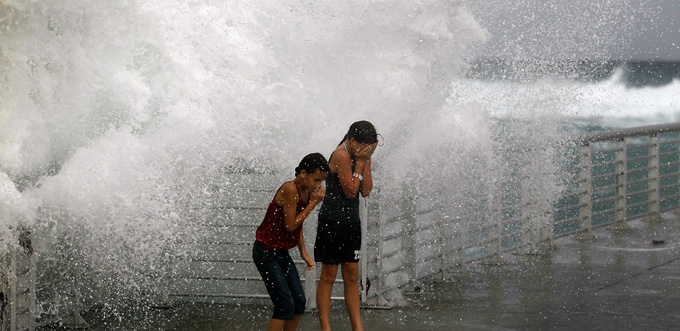
| Extreme weather is one example of the effects of climate change we are already seeing today [GALLO/GETTY] |
| AW: One problem is an economic system that impels
each company within it to pursue growth - each company must seek new
investment funds by demonstrating greater growth potential than its
competitors. Another problem is a political system that is so heavily
corrupted by corporate cash, exacerbated by the absurd legal fiction
that a corporation is a person with constitutional rights to free
speech. Without those problems, we could have the kind of largely publicly funded campaigns adopted by other countries. I also think that for all its virtues, the constitutional checks and balances built into our system have brought us to gridlock - we really might want to consider the advantages of a parliamentary system in which the executive branch is headed by the leader of the majority party, as in England and many other parliamentary democracies. We have to be enlightened enough to take aggressive and expensive actions primarily for the benefit of our children and grandchildren. While individuals and families have been able to do this throughout history, it has proven very difficult for whole societies to do so. All these barriers are so daunting that we become overwhelmed by the sheer magnitude of it all. Here we face fundamental philosophical and psychological problems at both the individual and collective levels. |
| AW:Our most important problems can only be solved
by collective action - new policies and laws taken by government. That
requires that we act, above all, as citizens. I have watched over the
past 40 years as nearly every important institution in our society has
gradually shifted to encouraging us to see ourselves as individuals and
consumers as opposed to group participants and citizens.
We are all aware of this in advertising, but it has also become a
powerful trend in education and in government itself. We are encouraged
to believe that we can bring the changes we need by exercising our
"consumer vote" in the marketplace more effectively than by exercising
our citizenship - not just in voting, but also in public debate, in
participating in political parties, in the exercise of our professional
judgment, in educating our children, in participation in labour unions
and professional associations, in speaking out in our communities. Our "vote" through marketplace purchases can only bring about very limited change, and by thinking of ourselves more as consumers than as citizens we diminish our very dignity as human beings. We become a mouth that eats rather than a voice that speaks. That said, I am all for making the changes at the individual level that can help to create a culture of frugality, help us realise that we don't really need the great quantity of junk our civilisation produces, help us understand that we can make major social changes while actually improving our lives. Most of us want sociability and conviviality more than we want consumer goods. We can set a good example for others by showing that we can live more happily by consuming less. All of this can also help us live within a discipline of conscious choice rather than of allowing advertising to manipulate us. |
| AW: When Wes Jackson (president of The Land
Institute) recruited me to help him create an environmental studies
programme at Cal State-Sacramento, I was the all-purpose humanities and
social science person in a small core faculty. I learned all I could
from Wes about biology and genetics, and from other colleagues about oil
and mineral depletion, nuclear power, city and regional planning,
environmental law. It was a wonderful kind of second graduate school
experience that lasted through an entire career. I had always been attracted academically to what might be called the "pan-disciplines" such as geography, anthropology and history - disciplines that can reasonably take on almost any topic in human affairs. Salina, our small Kansas city, was known nationally for having one of the best public libraries of its size, and I spent a lot of time camped out in its stacks. My parents - intensely intellectual people who were too poor to go to college - assumed that any reasonable and moral person would be interested in nearly everything, and they hadn't been beaten into submission by professors to think differently. They were good models who were eager for knowledge of all kinds. They were looking for clear words and straightforward thinking, and they assumed that good thinking led to social responsibility and political action, to which they were dedicated. |
| AW: I don't know if there is a way out, but we have
to try. My own expectations are pessimistic because I don't see enough
people having sufficient awareness, understanding and determination to
bring about the major changes we need. And of course, contradicting what I just said, we don't really have to try. We only really have to try if we want to maintain our self-respect. If we want to stumble forward drunk while whistling in the dark, we could choose that. I maintain a certain faith that many people are going to make the right choices, and we can hope that is enough. I think Gramsci had it right when he said that he lived with "pessimism of the intellect, optimism of the will". And you have to take that seriously from a guy who wrote while in prison for his political beliefs. |
Sunday, November 13, 2011
Where there's a will...

An old Italian gentleman lived alone in New Jersey . He wanted to plant his annual tomato garden, but it was very difficult work, as the ground was hard. His only son, Vincent, who used to help him, was in prison. The old man wrote a letter to his son and described his predicament:
Dear Vincent, I am feeling pretty sad because it looks like I won’t be able to plant my tomato garden this year. I’m just getting too old to be digging up a garden plot. I know if you were here my troubles would be over. I know you would be happy to dig the plot for me, like in the old days. Love, Papa
A few days later he received a letter from his son.
Dear Papa, Don’t dig up that garden. That’ s where the bodies are buried. Love, Vinnie
At 4 a.m. The next morning, FBI agents and local police arrived and dug up the entire area without finding any bodies. They apologized to the old man and left. That same day the old man received another letter from his son.
Dear Papa, Go ahead and plant the tomatoes now. That’s the best I could do under the circumstances.
Love you,
Vinnie
from VegSource.com
Subscribe to:
Posts (Atom)