Posts
Posts


Angus Wright has a way of saying things we may not want to hear in a way that's hard to ignore.
An example: During a meeting of environmentalists about shaping the public conversation on our most pressing ecological crises, folks were wrestling with how to present an honest analysis in accessible language. We needed to figure out how to talk about the bad news and the need for radical responses, without turning people off. During the discussion about the effects of climate change, Wright offered a simple suggestion for a slogan: "No more water, the fire next time".
Those words from a black spiritual, made famous by James Baldwin's borrowing for his 1963 book The Fire Next Time, are usually invoked metaphorically. Wright was suggesting that we might want to consider the phrase literally.
After a summer of drought and forest fires in Texas where I live, Wright's comment reminded me that climate disruption isn't part of some science-fiction future, but is unfolding around us in ways that are both complex and hard to predict, but devastating simple: We're in deep trouble, ecologically and culturally, as we try to face up to unprecedented planetary problems in a society in denial.
Wright is one of our most astute observers of these troubles. His willingness to face these issues, and his ability to grasp the interplay of complex systems, is no surprise to readers of his book The Death of Ramon Gonzalez: The Modern Agricultural Dilemma, first published in 1990 and revised for a 2005 edition. Looking at one region in Mexico, Wright explains how political and economic power, combined with the arrogance of experts who believe they have all the answers, have radically changed people, communities and land - mostly for the worse.
Though Wright speaks bluntly about these grim realities, he hasn't given up trying to change the trajectory of a society that so often denies or minimises the threat.
A retired professor of environmental studies at California State University, Sacramento, Wright is the chair of the board of The Land Institute, which is committed to the research and organising necessary for a truly sustainable agriculture. His writing also focuses on those issues - he is co-author of To Inherit the Earth: The Landless Movement in the Struggle for a New Brazil (with Wendy Wolford) and Nature's Matrix: Linking Agriculture, Conservation, and Food Sovereignty (with Ivette Perfecto and John Vandermeer).
Because Wright has a knack for presenting complex ideas in plain language, I asked him to respond to some crucial questions about how to understand our predicament and options. Can we face reality honestly without feeling overwhelmed? Wright suggests we can.
Robert Jensen: Your invocation of "the fire next time", with its Biblical roots, suggests a moral warning and the potential catastrophe if we are not up to the moral task. Before we get to questions of politics and science, what do you think is the right moral framework for understanding the ecological crises?
| Angus Wright: There certainly is a moral question,
but I think we in the environmental movement have wasted a lot of time
dealing with it at the wrong level. I get frustrated with the deep
tendency of so many Americans to be more worried about the task of
saving their souls rather than solving the problem. I am not as
interested in the purity of intention or personal practice as I am
concerned about correctly identifying the nature of problems and getting
to work in an organised way to solve them. The emphasis, for example, on whether individuals are hypocritical when their personal consumption is out of sync with their political/ecological views has been a diversion. It undermines effective organisation and helps to maintain the myth that it is personal rather than collective action that really matters. When we think we are saving ourselves, we tend to become self-righteous in ways that separate us from the other people we need to work with in order to effect societal change. The important moral question is social, not individual. How do we collectively figure out ways to live that don't require that we destroy the planet's capacity to sustain life? |
| AW:Humans are capable of immense creativity and
sacrifice, which has been demonstrated in crisis situations such as
wars, famines, migrations and in the building and defence of homes and
communities. In my work, I have been frequently reminded of the
incredible sacrifices Mexican immigrants make to earn a little money to
send back to their families over years, sacrifices that have both an
individual and a community aspect.
Many of us know how hard and how creatively our parents and ancestors
worked to provide us with the lives we now take for granted. Of course,
such effort can have negative as well as positive aspects - for
example, the creation of the majority European culture of the Americas
at the expense of Native Americans and Africans. People are also capable
of stunning complacency, greed, and divisiveness. The secret we seek is what inspires humans to act positively and creatively in the face of huge challenges. As humanity faces the environmental crisis, this is its greatest challenge: How do we elicit the kind of collective and individual action and creativity that will be needed? I think previous experience implies that it cannot be fear alone, nor opportunity alone, nor persuasion alone, nor organisation alone, but a blend of these elements, with much else. We have been able to lump these things together successfully in the past in something called patriotism - a powerful force for good and ill - and now we need something like a planetary patriotism. But no planetary patriotism can be built without acknowledging and dealing with the major things that divide us as well as the challenge that must unite us. Putting on a happy face won't cut it. |
 |
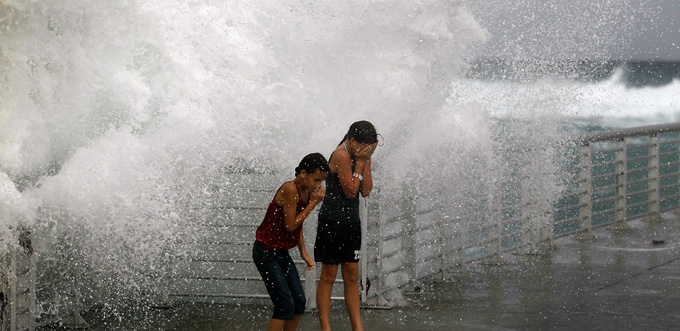
| Extreme weather is one example of the effects of climate change we are already seeing today [GALLO/GETTY] |
| AW: One problem is an economic system that impels
each company within it to pursue growth - each company must seek new
investment funds by demonstrating greater growth potential than its
competitors. Another problem is a political system that is so heavily
corrupted by corporate cash, exacerbated by the absurd legal fiction
that a corporation is a person with constitutional rights to free
speech. Without those problems, we could have the kind of largely publicly funded campaigns adopted by other countries. I also think that for all its virtues, the constitutional checks and balances built into our system have brought us to gridlock - we really might want to consider the advantages of a parliamentary system in which the executive branch is headed by the leader of the majority party, as in England and many other parliamentary democracies. We have to be enlightened enough to take aggressive and expensive actions primarily for the benefit of our children and grandchildren. While individuals and families have been able to do this throughout history, it has proven very difficult for whole societies to do so. All these barriers are so daunting that we become overwhelmed by the sheer magnitude of it all. Here we face fundamental philosophical and psychological problems at both the individual and collective levels. |
| AW:Our most important problems can only be solved
by collective action - new policies and laws taken by government. That
requires that we act, above all, as citizens. I have watched over the
past 40 years as nearly every important institution in our society has
gradually shifted to encouraging us to see ourselves as individuals and
consumers as opposed to group participants and citizens.
We are all aware of this in advertising, but it has also become a
powerful trend in education and in government itself. We are encouraged
to believe that we can bring the changes we need by exercising our
"consumer vote" in the marketplace more effectively than by exercising
our citizenship - not just in voting, but also in public debate, in
participating in political parties, in the exercise of our professional
judgment, in educating our children, in participation in labour unions
and professional associations, in speaking out in our communities. Our "vote" through marketplace purchases can only bring about very limited change, and by thinking of ourselves more as consumers than as citizens we diminish our very dignity as human beings. We become a mouth that eats rather than a voice that speaks. That said, I am all for making the changes at the individual level that can help to create a culture of frugality, help us realise that we don't really need the great quantity of junk our civilisation produces, help us understand that we can make major social changes while actually improving our lives. Most of us want sociability and conviviality more than we want consumer goods. We can set a good example for others by showing that we can live more happily by consuming less. All of this can also help us live within a discipline of conscious choice rather than of allowing advertising to manipulate us. |
| AW: When Wes Jackson (president of The Land
Institute) recruited me to help him create an environmental studies
programme at Cal State-Sacramento, I was the all-purpose humanities and
social science person in a small core faculty. I learned all I could
from Wes about biology and genetics, and from other colleagues about oil
and mineral depletion, nuclear power, city and regional planning,
environmental law. It was a wonderful kind of second graduate school
experience that lasted through an entire career. I had always been attracted academically to what might be called the "pan-disciplines" such as geography, anthropology and history - disciplines that can reasonably take on almost any topic in human affairs. Salina, our small Kansas city, was known nationally for having one of the best public libraries of its size, and I spent a lot of time camped out in its stacks. My parents - intensely intellectual people who were too poor to go to college - assumed that any reasonable and moral person would be interested in nearly everything, and they hadn't been beaten into submission by professors to think differently. They were good models who were eager for knowledge of all kinds. They were looking for clear words and straightforward thinking, and they assumed that good thinking led to social responsibility and political action, to which they were dedicated. |
| AW: I don't know if there is a way out, but we have
to try. My own expectations are pessimistic because I don't see enough
people having sufficient awareness, understanding and determination to
bring about the major changes we need. And of course, contradicting what I just said, we don't really have to try. We only really have to try if we want to maintain our self-respect. If we want to stumble forward drunk while whistling in the dark, we could choose that. I maintain a certain faith that many people are going to make the right choices, and we can hope that is enough. I think Gramsci had it right when he said that he lived with "pessimism of the intellect, optimism of the will". And you have to take that seriously from a guy who wrote while in prison for his political beliefs. |